
Table Of Contents
Hey folks!
Welcome to the THOUSIF Inc. – INDIA blog, where we dive deep into the latest developments shaping our nation’s economy and workforce.
Today, on this landmark date of November 21, 2025, we are talking about something that’s set to redefine how work happens in India.
The government has just made the Four Labour Codes official, and it is a big deal for everyone, from daily wage earners to corporate executives.
Suppose you have ever wondered why our old labour laws felt like they were from another era, or how modern jobs like gig driving fit into the picture.
Four Labour Codes
This detailed report has you covered.
We will break it all down in simple terms, with real examples, fresh updates from today’s announcements, and insights to help you understand the impact.
Let us jump in and see how these changes are building a stronger, fairer India.
Introduction To The Four Labour Codes
Picture this: India, with its massive workforce of over 500 million people, has been operating under labour laws that date back to the 1930s and 1950s.
These were crafted in a time of colonial rule and early independence, when factories dominated, jobs were mostly lifelong, and the gig economy was unheard of.
Fast forward to today, and our work world includes app-based deliveries, remote freelancing, and global supply chains.
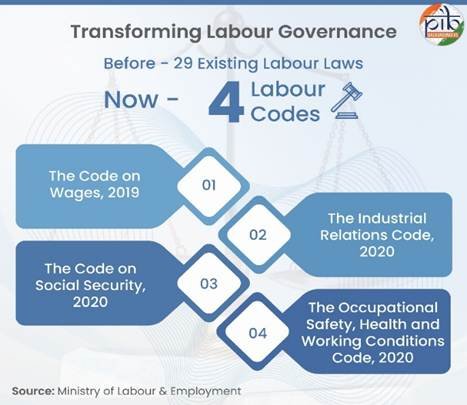
However, we were stuck with 29 fragmented central labour laws that created confusion, high costs for businesses, and gaps in worker protections.
That is where the Four Labour Codes come in.
Effective right now, from November 21, 2025, these codes consolidate those 29 laws into four streamlined ones:
- Code on Wages, 2019
- The Industrial Relations Code, 2020
- The Code on Social Security, 2020
- The Occupational Safety, Health
- Working Conditions Code, 2020
This is not just paperwork; it is a transformational overhaul aimed at better wages, enhanced safety, comprehensive social security, and overall welfare.
As announced by the Press Information Bureau (PIB), this move simplifies and streamlines labour laws, heralding “transformational change” for India’s workforce.
It is all about creating a protected, future-ready workforce that supports resilient industries and drives employment growth under the banner of Aatmanirbhar Bharat, India’s self-reliance initiative.
Why does this matter?
For workers, it means fairer pay, job security, and benefits that follow you wherever you go.
For businesses, it is easier to comply and grow with flexibility.
And for the economy?
It is a boost to attract investors, as highlighted in Bloomberg’s report on how these reforms make India more appealing globally.
Recent posts on X (formerly Twitter) are buzzing with excitement, like from @CAChirag, noting how it simplifies compliance for businesses while empowering over 50 crore workers.
In this report, we will explore the history, break down each code, compare old vs. new, detail sector benefits, discuss broader reforms, address challenges, and look at global contexts.
By the end, you will have a clear picture of how these codes could change lives.
Historical Context And Need For Reform
To appreciate the Four Labour Codes, we need to go back in time.
India’s labour laws originated in the pre-Independence era, influenced by British colonial needs.
Laws like the Factories Act of 1948 or the Minimum Wages Act of 1948 were progressive for their time, but became outdated as the economy evolved.
By the 1990s, globalization brought new challenges: informal jobs surged, women entered the workforce in droves, and technology disrupted traditional employment.
While countries like Germany consolidated their labour codes in the 1970s and China streamlined theirs in the 2000s for flexibility, India lagged with its 29 central laws (plus state variations), leading to over 1,200 sections of regulations.
This fragmentation meant high compliance burdens, multiple registrations, inspections, and filings, which stifled small businesses.
Workers suffered too: only about 19% had social security in 2015, leaving millions vulnerable.
Migrant workers, gig economy participants, and women faced exploitation, with no portable benefits or equal opportunities.
The push for reform gained momentum in the 2010s, with parliamentary committees recommending consolidation.
The codes were passed in 2019-2020 amid debates, delayed by COVID-19 and stakeholder consultations, and finally implemented today.
As per The Hindu’s coverage, this enforcement marks the end of a long-pending overhaul.
Trade unions raised concerns during drafting, but the government incorporated feedback, promising ongoing dialogues for rules.
PIB release emphasizes how these codes align with global standards, ensuring social justice and boosting India’s competitiveness.
In essence, the need was clear: modernize to match the “evolving world of work,” reduce uncertainty, and empower both workers and enterprises.
This reform is not radical; it is evolutionary, building on successes like expanding social security coverage to 64% by 2025.
Overview Of Each Labour Code
Let us unpack the four codes one by one.
Each targets specific areas but works together for holistic reform.
We will explain what they cover, key features, and real-world implications in simple terms.
The Code on Wages, 2019, merges four old laws (like the Payment of Wages Act and Minimum Wages Act) into one focused on fair and timely compensation.
Key highlights include universal minimum wages, where previously they applied only to “scheduled” industries, leaving many out.
Now, every worker gets a statutory right to minimum pay, with a national floor wage set by the central government to ensure a decent living standard, covering basics like food, housing, and education.
Timely payments and no deductions are enforced, with wages paid on time (e.g., by the 7th for monthly salaries), no unauthorized cuts, clearer bonuses, and overtime at double pay.
A shop assistant in a small town who earned below subsistence now has legal backing for better pay.
As the Economic Times reports, this benefits over 40 crore unorganized workers.
This code promotes financial security, reduces poverty, and boosts consumer spending.
The Industrial Relations Code, 2020, handles disputes, unions, and employment terms, combining three laws (like the Industrial Disputes Act).
It offers flexible hiring and firing by raising the threshold for government permission on layoffs from 100 to 300 workers, giving businesses agility, but mandates notice and retrenchment benefits.
Faster dispute resolution comes via two-member tribunals for quicker settlements. Workers can approach directly after conciliation, cutting court delays.
Union reforms simplify recognition of trade unions and strikes, with notice periods to balance rights.
A manufacturing firm can now scale up or down without endless approvals, encouraging job creation.
LiveLaw notes this includes overtime at double wages and safety norms.
It is pro-employment, fostering trust between workers and employers.
The Code on Social Security, 2020, is the broadest, merging nine laws to extend protections to all, especially the vulnerable.
It includes gig and platform inclusion by defining “gig work” and requiring aggregators (e.g., Swiggy) to contribute 1-2% of turnover for funds.
Aadhaar-linked Universal Account Numbers ensure portable benefits like PF and ESIC across states.
Expanded coverage makes ESIC pan-India, voluntary for small firms but mandatory in hazards, and includes gratuity after one year for fixed-term workers.
A delivery rider hurt on the job gets insurance, as Hindustan Times details for platforms like Zomato.
This widens the net, from 19% coverage in 2015 to potentially 90%+, per government estimates.
The Occupational Safety, Health, and Working Conditions Code, 2020, consolidates 13 laws for safe workplaces.
It sets health and safety standards with mandatory free annual check-ups (over 40s), safety committees (500+ workers), and training.
Hours are capped at 8-12 daily/48 weekly, with double overtime.
Women’s empowerment allows night shifts and hazardous jobs with consent and safeguards like transport.
Plantation workers get protective gear and family ESI, reducing accidents.
Livemint highlights extensions to 400 million workers.
It shifts from punishment to prevention, with “facilitators” guiding compliance.
Key Changes: Before And After The Labour Codes
To see the shift, here is a detailed comparison table.
| Aspect | Before | After | Why |
|---|---|---|---|
| Employment Formalization | No mandatory appointment letters | Mandatory letters detailing role, pay, and rights for all workers. | Builds transparency, job security; and helps with loans/claims. |
| Social Security | Limited to the formal sectors; gig workers excluded | Universal coverage, including gig/platform; portable via Aadhaar UAN. | Protects vulnerable migrants; keeps benefits on the move. |
| Minimum Wages | Only scheduled jobs; uneven across states | Statutory for all; national floor wage. | Ensures decent living; reduces inequality. |
| Preventive Health | No free check-ups required | Annual free exams for over-40s; promotes a healthy culture. | Early detection saves lives and cuts healthcare costs. |
| Wage Timeliness | Delays are common, and there is no strict enforcement | Mandatory on-time pay; by the 7th for salaries. | Reduces financial stress, boosts morale/productivity. |
| Women Participation | Restrictions on nights/hazards | Allowed with consent, safety (transport, CCTV); equal pay. | Increases workforce participation and GDP growth. |
| ESIC Coverage | Area/industry-limited; small firms out | Pan-India; mandatory in hazards, voluntary elsewhere. | Expands to millions; better health access. |
| Compliance Burden | Multiple registrations/licenses/returns | Single PAN-India registration, license, and return. | Saves time/money for businesses; eases operations. |
The old system was patchy; the new is inclusive and efficient.
This table illustrates a major upgrade from a fragmented, outdated system to one that’s modern and worker-centric.
What is happening here is a shift toward inclusivity, where gaps like limited social security are filled, making life better for millions.
It is good because it reduces exploitation and boosts economic stability, though some critics say the flexibility in hiring could be bad if it leads to job insecurity without strong enforcement.
Sector Specific Benefits Of The Labour Codes
The codes tailor benefits to sectors, addressing unique needs.
We will detail each with tables, examples, and insights.
Fixed term workers (project based) often got shortchanged
Now:
| Benefit | Details | Example |
|---|---|---|
| Equal to Permanents | Same leave, medical, and social security. | IT contractor gets full PF like full-timers. |
| Gratuity After 1 Year | Eligibility from year one, not five. | Year-long gig ends with payout. |
| Equal Wages | No pay disparity. | Boosts income stability. |
| Reduces Contract Abuse | Promotes direct hiring. | Firms avoid the middlemen for fairer deals. |
In this setup, fixed-term employment is becoming more secure and attractive, transforming temporary roles into ones with real protections.
This is good as it encourages companies to hire directly, reducing exploitation and providing financial perks like early gratuity, which builds worker loyalty; however, it could be bad if overused to avoid permanent hires, potentially leading to less job stability.
Gig and platform workers form a booming sector with 8 crore people
| Benefit | Details | Example |
|---|---|---|
| Legal Definitions | First-time recognition of gig/platform/aggregators. | Delivery apps are accountable. |
| Contributions | 1-2% turnover (capped at 5% worker pay). | Funds insurance/PF. |
| Portable Benefits | Aadhaar UAN for interstate access. | Migrant rider claims anywhere. |
Here, gig work is gaining formal recognition, with platforms contributing to funds that provide essential safety nets.
This is largely good, offering security to previously unprotected workers and enabling portability for migrants, which enhances dignity and reduces poverty; on the bad side, the capped contributions might not suffice for all needs if turnover is low, potentially straining small aggregators.
Contract workers through agencies are now protected
| Benefit | Details | Example |
|---|---|---|
| Social Security | Like permanents; principal employer provides. | Factory temp gets health benefits. |
| Gratuity | After one year. | Quick eligibility. |
| Health Check-Ups | Free annual. | Preventive care. |
Contract labour is leveling up to match permanent roles, with employers ensuring benefits extend fully.
This change is positive, closing the gap in treatment and promoting health through check-ups, which can prevent costly illnesses; but it might be negative if principal employers pass costs to contractors, indirectly affecting wages.
Women workers are seeing pushes for gender equality
| Benefit | Details | Example |
|---|---|---|
| No Discrimination | Equal pay; transgender inclusion. | Engineer earns same as men. |
| Flexible Roles | Nights/hazards with consent, safety. | Night shift in tech for higher pay. |
| Grievance Representation | Women on committees. | Faster harassment resolution. |
| Family Expansion | Parents-in-law as dependents. | Broader coverage. |
Opportunities for women are expanding dramatically, with equal access to roles and stronger support systems.
This is excellent for boosting female participation and economic growth, as it empowers higher earnings and family coverage; the downside could be safety risks in hazardous jobs if safeguards aren’t strictly implemented.
Youth workers as new entrants are getting protected
| Benefit | Details | Example |
|---|---|---|
| Wage Guarantee | Minimum for all. | Grad starts fair. |
| Appointment Letters | Formal history. | Easier future jobs. |
| Paid Leaves | Mandatory wages on off days. | No income loss. |
Young people entering the market are now starting on firmer ground with guaranteed basics.
This is beneficial for building careers without exploitation, fostering formal employment and financial independence; however, it might be challenging for small employers to comply, potentially slowing entry-level hiring.
MSME workers in small businesses (11 crore jobs) benefit too
| Benefit | Details | Example |
|---|---|---|
| Security Coverage | Based on size. | Shop worker gets ESIC. |
| Facilities | Canteens, rest areas. | Better comfort. |
| Hours/Overtime | Standard, double pay. | Fair work-life. |
Small enterprises are providing more amenities and protections, making jobs in them more appealing.
This is good for worker well-being and business growth through reduced burdens, but bad if compliance costs strain tiny MSMEs, leading to closures or informal shifts.
Beedi and cigar workers in traditional, home-based roles
| Benefit | Details | Example |
|---|---|---|
| Wages | Guaranteed minimum. | Rural roller earns more. |
| Hours Cap | 8-12 daily/48 weekly. | Prevents exhaustion. |
| Bonus | After 30 days. | Motivation boost. |
These informal workers are gaining structure with capped hours and bonuses.
It is positive for health and income in vulnerable rural areas, reducing overwork; the negative could be reduced flexibility for piece-rate work, affecting earnings if hours are strictly limited.
Plantation workers on remote farms
| Benefit | Details | Example |
|---|---|---|
| Code Applicability | Over 10 workers/5 hectares. | Tea picker gets gear. |
| Safety/Equipment | For chemicals. | Fewer accidents. |
| ESI/Education | Family medical, kids’ schools. | Holistic support. |
Remote agricultural work is modernizing with safety and family benefits.
This is highly beneficial for preventing hazards and supporting education, improving lives in isolated areas; drawbacks include enforcement challenges in remote spots, potentially leaving some uncovered.
Audio-visual and digital media workers in creative fields
| Benefit | Details | Example |
|---|---|---|
| Benefits | For artists, journalists. | Stuntman insured. |
| Letters | Clear terms. | Dispute-proof. |
| Overtime | Double pay. | Fair for long hours. |
Freelance-heavy media is getting formalized with clear entitlements.
Good for protecting irregular workers like stunt artists, ensuring fair pay; bad if overtime rules disrupt creative schedules, like late-night shoots.
Mine workers in hazardous environments
| Benefit | Details | Example |
|---|---|---|
| Accident Coverage | Includes commuting. | Way-to-work injury covered. |
| Standards | National OSH. | Better safety. |
| Hours | Capped for balance. | Healthier life. |
Mining is safer with extended coverage and standards.
This is crucial for life-saving measures in risky jobs, reducing fatalities; the con might be operational slowdowns from hour caps, affecting productivity.
Hazardous industry workers in chemicals or factories
| Benefit | Details | Example |
|---|---|---|
| Check-Ups | Free annual. | Early detection. |
| Committees | On-site monitoring. | Quick risk fixes. |
Focus is on prevention in dangerous sectors.
Positive for health monitoring and accountability, preventing disasters; negative if committees add bureaucracy without real action.
Textile workers are often migrant-heavy
| Benefit | Details | Example |
|---|---|---|
| Migrant Perks | Equal pay, portable PDS. | UP worker in TN keeps rations. |
| Claims | Up to 3 years. | Recover dues. |
Migrants in textiles get portability and recovery options.
Good for equity and support during moves, reducing hardship; bad if claim processes are slow, delaying justice.
IT and ITES workers in the tech sector.
| Benefit | Details | Example |
|---|---|---|
| Pay Timing | By the 7th. | Budget planning. |
| Equality | No gaps. | Women thrive. |
| Disputes | Quick resolution. | Safer environment. |
Tech jobs are more timely and equitable.
Beneficial for morale and innovation in fast-paced fields; potential issue if strict timelines disrupt global operations.
Dock workers at ports
| Benefit | Details | Example |
|---|---|---|
| Recognition | Legal protections. | Temp gets PF. |
| Facilities | First aid, clean areas. | Decent conditions. |
Port work gains decency and security.
Good for trade efficiency through better conditions; bad if facilities cost burden small ports.
Export sector workers are driving growth
| Benefit | Details | Example |
|---|---|---|
| Perks | Gratuity/PF for temps. | Garment workers are secure. |
| Leaves | After 180 days. | Rest time. |
| Safety for Women | Consent-based nights. | Higher income. |
Exports get a boost with worker perks.
Positive for competitiveness and income; negative if safety for nights isn’t uniform.
Broader Reforms And Innovations
Beyond specifics, the codes introduce game-changers: National floor wage for living standards, adjustable regionally.
Gender neutrality prohibits discrimination and includes transgender individuals.
The facilitator system has an inspector’s guide rather than punishment.
Single compliance with one registration replaces multiples.
OSH Board sets harmonized safety standards.
Higher thresholds for small units (under 300) have lighter rules but full worker safeguards.
Today’s SA News Karnataka post notes consolidation protects 400 million, with portable benefits—innovations like UAN portability address migration, a big issue for 10 crore interstate workers.
Potential Challenges And Criticisms
No reform is perfect.
Trade unions worry about diluted bargaining—e.g., easier layoffs could favor employers.
As @sanewsKarnataka tweets, unions express concerns over weakened power—implementation hurdles: State variations in rules, tech gaps for tracking, and training needs for MSMEs.
LiveLaw mentions unclear retrenchment, potentially leading to disputes.
Businesses face short-term costs for payroll updates.
The government promises transitions with old laws intact initially, and stakeholder input.
Overall, the benefits outweigh, but monitoring is key.
Global Alignment And Comparisons
These codes align with ILO conventions on safety and security.
Compared to China’s strict centralization, India’s is flexible. Vs. USA/UK, it adds gig protections they lack.
Bloomberg sees it attracting investors like post-reform Singapore.
Globally, it’s praised for expanding coverage, earning recognition for jumping from 19% to 64% social protection.
Trivia
Did you know the codes cut provisions by 61%, from 1,200+ sections? A massive declutter!
Conclusion
The Four Labour Codes, effective today, mark a new era for India’s workforce, fairer, safer, and more inclusive.
At THOUSIF Inc. – INDIA, we’re optimistic about how this fosters growth while protecting people.
From gig workers to MSMEs, the ripple effects will be huge.
If you are impacted, share your thoughts in the comments!
Check out our other reports on economic trends, and stay tuned for updates.
Frequently Asked Questions (FAQs) on India’s Four Labour Codes
Based on online searches and discussions, here are 10 FAQs that people are commonly asking about the Four Labour Codes.
These draw from trending queries on wages, social security, implementation challenges, and sector impacts.
We have answered them simply and informatively to clear up common doubts.
What are the Four Labour Codes, and when do they come into effect?
The Four Labour Codes refer to the Code on Wages, 2019; the Industrial Relations Code, 2020; the Code on Social Security, 2020; and the Occupational Safety, Health and Working Conditions Code, 2020. They consolidate 29 old labour laws into a modern framework. They became effective on November 21, 2025, as announced by the Government of India, aiming to simplify regulations and enhance worker protections. This rollout addresses long-standing needs for updated laws in a changing economy.
How do the Four Labour Codes impact minimum wages and timely payments?
Under the Code on Wages, 2019, minimum wages are now statutory for all workers, not just scheduled industries, with a national floor wage ensuring a decent living standard. Timely wage payments are mandatory, such as salaries by the 7th of the month in sectors like IT. This boosts financial security but requires businesses to update payroll systems. People often ask this due to concerns over inconsistent pay in informal jobs.
What changes do the Labour Codes bring for gig and platform workers?
The Code on Social Security, 2020, defines “gig work” and “platform work” for the first time, requiring aggregators to contribute 1-2% of turnover (capped at 5%) to social security funds. Workers get portable benefits via Aadhaar-linked accounts, including PF and ESIC. This provides much-needed protection for around 8 crore gig workers, though questions arise about enforcement on small platforms.
How do the new Labour Codes affect women workers’ rights and participation?
The Occupational Safety, Health and Working Conditions Code, 2020, allows women to work night shifts and in hazardous roles with consent and safety measures like transport and CCTV. It prohibits gender discrimination, ensures equal pay, and expands family definitions to include parents-in-law. This promotes higher workforce participation and income, potentially adding to GDP, but safety implementation is a common concern.
What are the key benefits for fixed-term and contract workers under the Labour Codes?
Fixed-term employees now receive benefits equal to permanent workers, including gratuity after one year (down from five) and social security. Contract workers get health benefits from principal employers. This reduces exploitation and promotes direct hiring, but queries often focus on whether it might lead to more temporary jobs over permanent ones.
How do the Labour Codes address social security coverage for unorganized and migrant workers?
The Code on Social Security expands ESIC and PF to unorganized sectors, including migrants, with portable benefits and PDS rations. Coverage jumps from limited areas to pan-India, voluntary for small firms but mandatory in hazardous areas. This is praised for reaching 90%+ of workers, though people ask about digital access issues for migrants without Aadhaar.
What implementation challenges are associated with the Four Labour Codes?
Challenges include state variations in rules, high compliance costs for MSMEs (like payroll updates), and union concerns over diluted rights, such as easier layoffs. Trade unions criticize potential job insecurity, while businesses worry about short-term disruptions. The government plans stakeholder consultations, but delays in full rollout have sparked many online questions.
How do the Labour Codes simplify compliance for employers and reduce burden?
They introduce single registration, PAN-India licenses, and one return instead of multiples, cutting filings from over 900 to a few. Inspector-facilitators focus on guidance over punishment. This eases doing business, especially for small units, but FAQs often probe if it truly benefits without increasing costs for training and tech.
9. What health and safety improvements come from the Occupational Safety Code?
It mandates free annual health check-ups for workers over 40, safety committees in large establishments, and capped working hours (8-12 daily/48 weekly) with double overtime. Standards for hazards like chemicals are nationalized. This promotes preventive healthcare, but questions arise about enforcement in remote or informal sectors like plantations.
Do the Four Labour Codes align with global standards and benefit India’s economy?
Yes, they align with ILO conventions on safety, security, and equality, making India more competitive like Singapore or China. They boost employment, skilling, and growth by reducing red tape, with social security coverage rising to 64%+. However, critics ask if they sufficiently protect informal workers (90% of the workforce) amid globalization.
About Author