
Table Of Contents
Battle Of Longewala 1971
The Battle of Longewala remains one of the most inspiring chapters in Indian military history.
On a freezing December night in 1971, just 120 Indian soldiers, led by Major Kuldip Singh Chandpuri, held off a massive Pakistani armored assault in the vast Thar Desert of Rajasthan.
Outnumbered more than 20 to 1 and lacking tanks of their own, these men achieved what seemed impossible: a stunning defensive victory that halted an enemy brigade and contributed significantly to India’s triumph in the 1971 Indo-Pak War.
This is the story of raw courage, brilliant leadership, clever tactics, and perfect timing, a modern-day tale often compared to the ancient stand of the 300 Spartans at Thermopylae, but with a victorious ending.
Historical Context: Why The War Happened
To understand Longewala, we must step back to the events unfolding across the border.
In 1971, Pakistan was divided into two wings: West Pakistan and East Pakistan (now Bangladesh), separated by over 1,600 kilometers of Indian territory.
East Pakistan, home to the majority of the population, felt marginalized by the Urdu-speaking elite in the West.
The crisis exploded after the 1970 elections, when Sheikh Mujibur Rahman’s Awami League won a clear majority but was denied power.
On March 25, 1971, the Pakistani military launched Operation Searchlight – a brutal crackdown on Bengali nationalists.
What followed was widespread atrocities, including mass killings and displacement.
Nearly 10 million refugees flooded into India, creating one of the most significant humanitarian crises of the century.
India, under Prime Minister Indira Gandhi, provided shelter and support to the Mukti Bahini (Bangladeshi freedom fighters).
As tensions escalated, war became inevitable.
Pakistan, sensing India’s focus on the East, planned a diversionary offensive in the West to capture territory for bargaining.
In Rajasthan’s Thar Desert, they assembled a powerful armored force to thrust through Longewala toward Jaisalmer and beyond.
India’s strategy was the opposite: defend firmly in the West while launching a decisive offensive in the East to liberate Bangladesh quickly.
On December 3, 1971, Pakistan struck Indian airfields.
India responded with full mobilization, and the 13-day war began.
Longewala Outpost
Longewala was not a fortress, just a forward border post operated by ‘A’ Company of the 23rd Battalion, Punjab Regiment, augmented by Border Security Force (BSF) personnel.
Approximately 120 soldiers held basic defenses: sandbag bunkers, trenches, barbed wire, medium and light machine guns, mortars, and crucially, one jeep-mounted 106mm recoilless rifle – their only effective anti-tank weapon.
The terrain was key. Perched on a prominent dune, the post offered excellent visibility and fields of fire.
The surrounding soft dunes could bog down heavy vehicles, while open ground exposed attackers.
Major Kuldip Singh Chandpuri, a seasoned Sikh officer from Punjab with a family tradition of military service, commanded the post.
His calm demeanor and quick thinking would soon become legendary.

Approaching Storm
On the evening of December 4, patrols detected unusual activity.
BSF camel troops under Assistant Commandant Bhairon Singh Rathore spotted signs of movement.
More critically, 2nd Lieutenant Dharam Vir Bhan’s army patrol shadowed a massive column, radioing vital intelligence: dozens of tanks and thousands of troops heading straight for Longewala.
Headquarters offered withdrawal permission, given the odds.
However, Major Chandpuri made his historic decision: “No withdrawal. We fight to the last man and last round.”
Defenses were hastily strengthened.
The masterstroke?
Fake minefield signs around the barbed wire.
Though only a handful of real mines existed, the bluff would prove devastatingly effective.
Night Of Fire: December 4-5, 1971
Around midnight, the Pakistani force, elements of the 18th Division with 40-60 tanks (mostly Chinese Type-59s) and 2,000-3,000 infantry, launched their assault under moonlight.
Tanks advanced cautiously, fearing mines, slowing dramatically and bunching up. Some bogged in soft sand.
Indian defenders held fire until the enemy closed, then unleashed disciplined volleys.
Wave after wave crashed against the dune.
Pakistani infantry charged across open ground; accurate machine-gun and mortar fire cut them down.
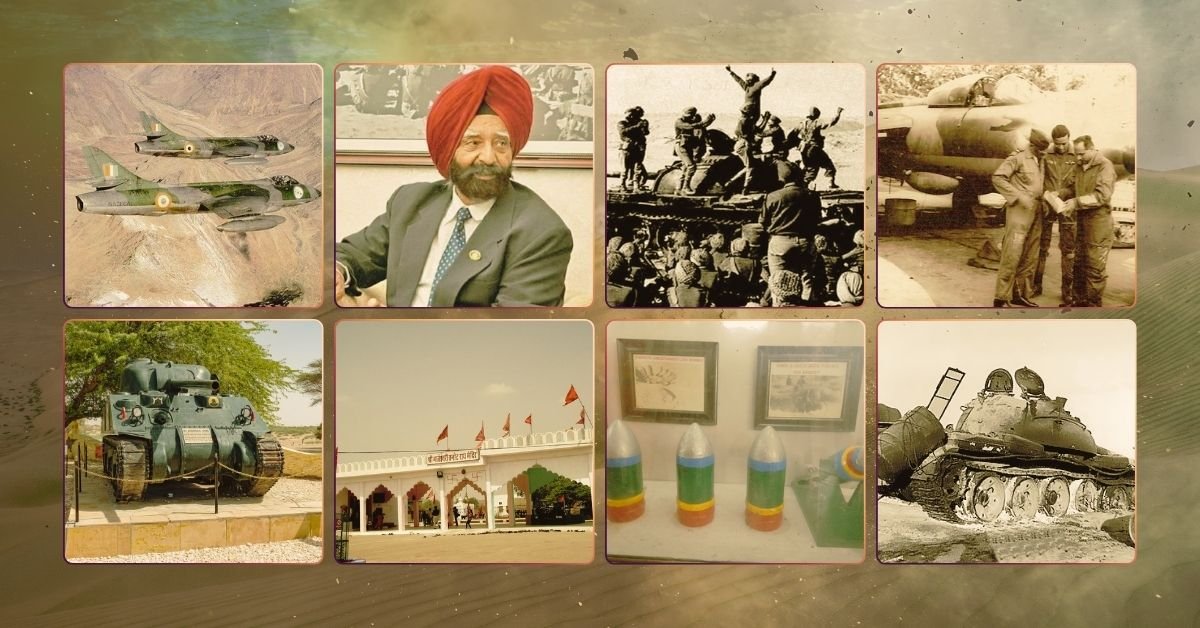
The mobile recoilless jeep darted between positions, knocking out several tanks in the darkness.
Major Chandpuri moved fearlessly from bunker to bunker, rallying his exhausted men.
Ammunition ran low, but runners redistributed rounds. Morale held firm.
By dawn, the Pakistanis were stalled, frustrated, and exposed.
Decisive Role Of The Indian Air Force
As the sun rose on December 5, Hawker Hunter aircraft from Jaisalmer’s No. 122 Squadron arrived.
With no Pakistani air cover in the sector, pilots faced a “turkey shoot”: tanks scattered, stuck, or abandoned across the open desert.
Rocket and cannon attacks devastated the column.
Over multiple sorties, the IAF destroyed or disabled dozens of tanks and vehicles.
Pakistani survivors fled on foot, abandoning equipment.
The ground defenders, having bought precious hours through the night, cheered as smoke plumes rose across the sands.
The Outcome
Indian losses: 2 killed, a few wounded.
Pakistani losses: Approximately 200 killed, 36-38 tanks destroyed or captured, over 100 vehicles lost.
The entire Pakistani thrust collapsed.
No significant territorial gains were made in Rajasthan, freeing Indian resources for the Eastern Front.
On December 16, Pakistan surrendered in Dhaka, 93,000 troops laying down arms, and Bangladesh was born.
Longewala’s stand played a crucial strategic role in this swift, decisive victory.
Miracle Of Tanot Mata
Adding a spiritual dimension, the nearby Tanot Mata Temple became legendary.
During both the 1965 and 1971 wars, hundreds of Pakistani shells landed around the temple but failed to explode.
Many attribute this to divine protection by the goddess.
Unexploded ordnance is still displayed there, and the temple remains under BSF care – a site blending faith and patriotism.
Heroes Of Longewala
- Brig. Kuldip Singh Chandpuri (MVC): The commander whose refusal to retreat defined the battle. He rose to the brigadier rank and passed away in 2018.
- 2nd Lt. Dharam Vir Bhan: Provided critical early warning through daring patrolling.
- Naik Subedar Bhairon Singh Rathore (Sena Medal): BSF hero whose camel patrol gave the first alerts.
- The unsung jawans of the Punjab Regiment and the IAF pilots who delivered devastating strikes.
Legacy And Remembrance
Today, the Longewala War Memorial stands proudly, displaying captured tanks and recounting the story through exhibits.
Combined with the Tanot Mata Temple, it forms a popular pilgrimage for patriots and tourists.
The 1997 blockbuster Border, directed by J.P. Dutta and starring Sunny Deol as a Chandpuri-inspired character, brought the battle to millions, becoming a cultural touchstone of patriotism.
Each Vijay Diwas (December 16), India remembers this victory and the broader 1971 triumph.

Lessons From Longewala
The battle offers timeless insights:
- Leadership and morale can overcome material superiority.
- Terrain knowledge and simple deception (the fake minefield) can multiply defensive strength.
- Integrated operations, ground forces holding until air power arrives, win modern battles.
- Courage is choosing duty over fear.
Longewala proves that determined defenders, fighting smartly on home ground, can defy overwhelming odds.
More than 50 years later, the spirit of those 120 soldiers continues to inspire.
In an uncertain world, their story reminds us: true strength lies not in numbers, but in unbreakable will.
Jai Hind!
Dedicated to Major Kuldip Singh Chandpuri, his brave men, and all who defend India’s borders.
About Author