
Table Of Contents
Threema App
Hey there, folks!
Welcome back to the blog from THOUSIF Inc. – INDIA, where we dive into the nitty-gritty of tech, security, and everything that keeps our digital world spinning.
I am sitting here in my cozy office, sipping on a strong cup of chai, thinking about how messaging apps have become such a big part of our lives.
We chat with friends, share family photos, and even handle work stuff on them.
However, what happens when one of these apps crosses the line from helpful tool to potential threat?
That is exactly what we are unpacking today with Threema, the Swiss messaging app that’s been making headlines for all the wrong reasons in India.
If you have ever wondered, “Why is Threema banned in India?” you are not alone.
It is a question that’s popped up in countless online forums, dinner table conversations, and even policy debates.
In this deep-dive blog post, we will explore the origins of Threema, the reasons behind its ban, the shocking connections to real-world security incidents, and what it all means for everyday users like you and me.
By the end, you will have a clear picture of this controversial app.
Let us get into it!
What Exactly Is Threema? A Quick Intro To The App
Picture this: You are looking for a messaging app that’s all about privacy.
No ads popping up, no data mining for creepy targeted ads, and encryption so tight that even the app makers cannot peek into your chats.
That is Threema in a nutshell.
Launched back in 2012 by a small team in Switzerland, a country famous for its banks and chocolate, but also for strict privacy laws, Threema quickly gained a reputation as a secure alternative to giants like WhatsApp or Telegram.
Unlike most free apps that make money by selling your data, Threema is a paid app.
You buy it once for a few bucks, and that is it.
No subscriptions, no hidden fees.
It uses end-to-end encryption, which basically means your messages are scrambled from the moment you send them until they reach the recipient.
Only you and the person you are talking to can unscramble them.
No middlemen, not even Threema’s servers.
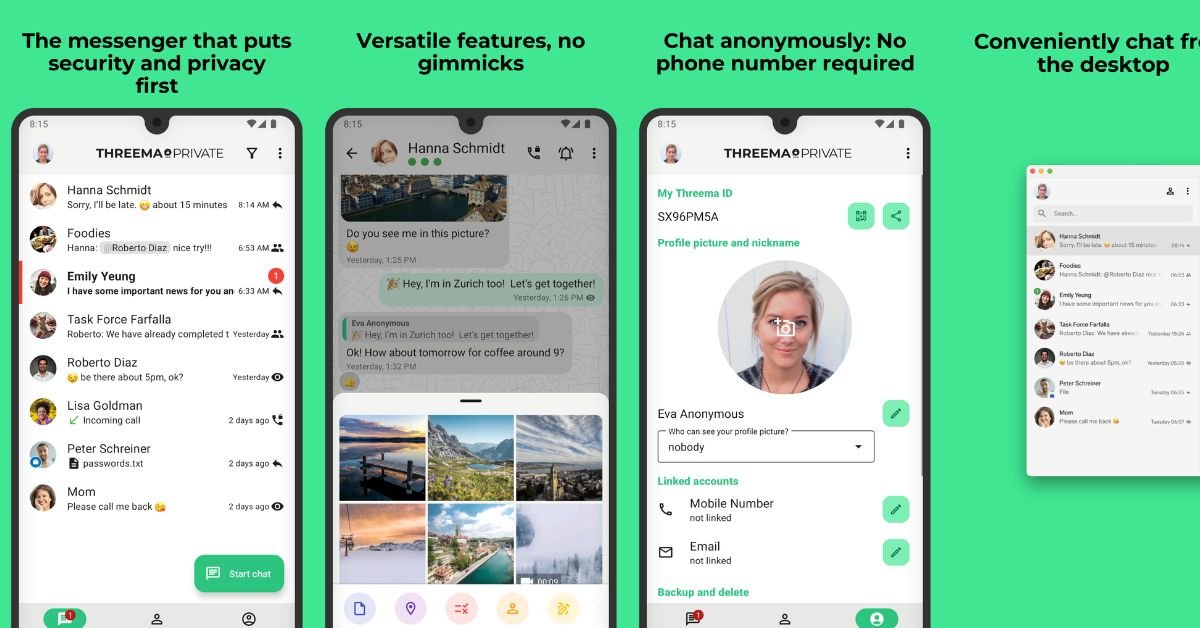
However, here is where it gets interesting: Threema does not require a phone number or email to sign up.
You get a unique ID generated randomly, like a secret code.
This anonymity is a double-edged sword, great for privacy enthusiasts, but a red flag for governments worried about misuse.
Plus, it has features like self-destructing messages, group chats, and even polls, all wrapped in a clean, user-friendly interface.
Over the years, Threema has grown to millions of users worldwide, especially in Europe, where data protection is a big deal.
However, in places like India, where security concerns often trump privacy, apps like this can stir up trouble.
We will circle back to that soon, but first, let us set the stage with a small quantity of history on messaging apps and why encryption matters.
The Evolution Of Messaging Apps: From SMS To Super-Secure Chats
Remember the good old days of SMS?
You would pay per message, and there was zero privacy; anyone with access to your phone bill could see who you texted.
Fast forward to the smartphone era, and apps like WhatsApp revolutionized communication, free texts, voice calls, and video chats all over the internet.
However, as these apps exploded in popularity, so did concerns about data breaches and surveillance.
Encryption became the hero of the story.
In simple terms, encryption is like putting your message in a locked box before sending it.
Only the right key opens it.
End-to-end encryption (E2EE) takes it further by ensuring the key is only with the sender and receiver.
Apps like Signal and Threema pioneered this, making it harder for hackers, companies, or governments to snoop.
However, here is the catch: While E2EE protects users from cyber threats, it also shields bad actors.
Terror groups, cybercriminals, and even everyday scammers can use it to plan without detection.
This tension between privacy and security is at the heart of many bans, including Threema’s in India.
To understand why, we need to look at India’s digital landscape.
India has over a billion mobile users, making it a hotspot for messaging apps.
WhatsApp alone has half a billion users here.
However, with great connectivity comes great responsibility, or so the government thinks.
Laws like the Information Technology Act, 2000, give authorities the power to block apps that threaten national security.
Moreover, that is exactly what happened with Threema.
The Ban Hammer Falls: Timeline Of Threema’s Troubles In India
Let us rewind to May 2023.
It was a typical summer day when news broke that the Indian government had banned 14 messaging apps, including Threema.
The move came under Section 69A of the IT Act, which allows blocking content or apps in the interest of sovereignty, defense, security, or public order.
No fanfare, no big announcement, just a quiet directive to telecom providers and app stores to restrict access.
Why then?
Intelligence agencies had been monitoring chatter in Jammu and Kashmir, a region plagued by insurgency.
Reports suggested that militants were using these apps to communicate with handlers across the border in Pakistan.
Threema, with its strong encryption and anonymity, was reportedly a favorite because it left no traces, no phone numbers, no metadata (that is, the extra info like timestamps and locations that apps often store).
The ban was not isolated.
It followed a pattern: In 2020, India banned TikTok and dozens of Chinese apps over border tensions.
Then came PUBG Mobile for similar security fears. By 2023, the focus shifted to encrypted messengers.
Threema joined the likes of Wickr Me, Briar, and Element on the naughty list.
Fast forward to 2025, and the ban is still in place. In fact, recent events have reinforced it.
Just this year, on November 13, 2025, reports emerged about a terror module in Faridabad using Threema in a high-profile case.
More on that bombshell later, pun intended.
To organize this timeline, here is a handy table:
| Year | Key | Details |
|---|---|---|
| 2012 | Threema Launch | Swiss app debuts with focus on privacy and E2EE. |
| 2020 | India Bans Chinese Apps | Sets precedent for security-based blocks. |
| May 2023 | Threema Banned | Along with 13 others under the IT Act Section 69A due to terror links in J&K. |
| 2024 | Ongoing Enforcement | Users bypass via VPNs, but official access is restricted. |
| November 2025 | Delhi Blast Link | The Faridabad module uses Threema for planning, highlighting ongoing threats. |
This table shows how the ban is not a one-off but part of a broader strategy.
Shocking Reasons Behind The Ban: Terror Links And National Security
Now, the meat of the matter: Why specifically Threema?
It is not because the app is inherently evil, far from it.
However, its features make it a perfect tool for covert operations.
Let us break it down.
First, the encryption.
Threema’s E2EE is top-notch, using open-source protocols that experts have audited.
Messages are deleted from servers after delivery, and there is no metadata storage.
That means no logs of who talked to whom, when, or from where.
For law enforcement, this is a nightmare.
In contrast, apps like WhatsApp store some metadata, which can be subpoenaed.
Second, anonymity.
No need for a SIM card or email.
Users get a Threema ID, which can be shared like a username.
This makes it hard to trace back to real identities.
In Jammu and Kashmir, where cross-border terrorism is a constant issue, handlers in Pakistan allegedly used such apps to instruct local operatives without leaving digital footprints.
Intelligence sources pointed to specific instances.
For example, in 2023 investigations, suspects in terror cases admitted to using Threema for secure communications.
The app’s ability to delete messages from both devices, sender and receiver, erases evidence, complicating forensics.
However, the real shocker came in 2025 with the Delhi Red Fort blast case.
A terror module based in Faridabad, involving suspects from Al Falah University, used Threema to share maps, plans, and sensitive documents.
They even set up a private server for added secrecy.
Despite the ban, they accessed it via workarounds, showing how persistent threats can be.
Reports from November 2025 investigations revealed that investigators somehow accessed metadata from these chats, but the app’s design made it tough.
This is not just hearsay.
Central intelligence agencies flagged these apps as being used by “terrorists and their supporters” in the region, the ban aimed to disrupt these networks, forcing them to less secure platforms where monitoring is easier.
To compare Threema’s features with other banned apps, check this table:
| App | Features | Reason |
|---|---|---|
| Threema | E2EE, no phone number, metadata-free, self-destruct messages | Used by J&K militants for Pakistan comms; 2025 Delhi blast link |
| Wickr Me | E2EE, ephemeral messages, secure file sharing | High anonymity aids criminal planning |
| Briar | P2P (peer-to-peer) over Bluetooth/WiFi, no internet needed | Offline mode is perfect for remote areas like J&K |
| Element (Matrix) | Open-source, federated servers, E2EE | The decentralized nature is hard to regulate |
| Zangi | Low-data usage, E2EE, voice distortion | Popular for evading surveillance in conflict zones |
As you can see, these apps share privacy-focused traits that, while beneficial for legitimate users, attract misuse.
How Threema Works: A Simple Breakdown For Non-Techies
Curious about the tech behind the ban?
Let us demystify it without getting too geeky.
Threema operates on a client-server model, but with twists for privacy.
When you install the app, it generates a public-private key pair.
Please think of the public key as your address; anyone can send to it.
The private key is your secret password to open messages.
When you send a text, it is encrypted with the recipient’s public key.
Only their private key decrypts it.
No central database of user info.
Chats are stored locally on your device.
If you delete a message, it has gone from both sides.
For groups, it is similar but with multiple keys.
One Cool Feature: Threema Web, which lets you chat from a browser, but still encrypted. However, this anonymity means that if your device is compromised, recovery is tricky, and there are no cloud backups.
In India, post-ban, downloading from official stores is impossible.
Users sometimes use VPNs (virtual private networks) to bypass geo-blocks, but that is risky; it could violate laws and expose you to malware.
Implications for Indian Users: Privacy Lost or Security Gained?
The ban raises big questions. On one hand, it is a win for national security.
Disrupting terror comms saves lives. India faces ongoing threats from groups like Lashkar-e-Taiba, and apps like Threema could facilitate attacks.
On the other hand, it is a blow to privacy.
Journalists, activists, and ordinary folks rely on secure messaging to speak freely.
Critics argue that the ban is overbroad. Why not target specific users instead of blanket blocks? Plus, determined bad guys will find alternatives, like custom apps or dark web tools.
In 2025, with rising cyber threats, the debate intensifies.
India’s push for data localization (storing data within borders) and traceability rules for apps clash with global privacy standards like GDPR in Europe.
For users, the ban means switching apps.
However, many still use Threema via VPNs, risking fines or worse.
It is a cat-and-mouse game.
Alternatives To Threema: Safer Choices For Secure Chatting
If Threema’s off-limits, what is next?
Plenty of options balance privacy and compliance.
- Signal: Open-source, E2EE, but requires a phone number. Popular in India, no ban yet.
- WhatsApp: E2EE for chats, but owned by Meta, which shares metadata with authorities when required.
- Telegram: Fast, but E2EE only in secret chats; group features are public-ish.
- Session: Similar to Threema, no phone number, but not banned (yet).
Here is a comparison table to help you choose:
| App | Encryption | Phone | Banned? | For |
|---|---|---|---|---|
| Signal | E2EE always | Phone yes | No | Privacy-focused users |
| E2EE for chats | Phone yes | No | Everyday messaging | |
| Telegram | E2EE optional | Phone yes | No | Large groups, channels |
| Session | E2EE, onion routing | No | No | Anonymity seekers |
| Threema | E2EE always | No | Yes | (Banned) Secure, paid |
Pick based on your needs: Signal for die-hard privacy, WhatsApp for convenience.
Global Perspective: How Other Countries Handle Encrypted Apps
India is not alone.
China bans most Western apps, forcing WeChat to use backdoors.
Russia blocked Telegram in 2018 over encryption keys, but lifted the block later.
The US debates forcing apps to provide access for investigations, like in the Apple-FBI iPhone case.
In Europe, Threema thrives due to strong privacy laws.
Switzerland, its home, mandates data protection but allows lawful intercepts.
India’s approach is proactive, prioritizing security over privacy.
Critics say it is authoritarian, but supporters point to real threats.
In 2025, with global tensions rising, more countries might follow suit.
Indian Laws Explained: Section 69A And Beyond
Section 69A is the key player.
It empowers the government to block public access to information if it threatens India’s integrity or security.
Process: A committee reviews requests, notifies app owners (if possible), and then issues orders. Related laws include the IT Rules 2021, requiring social media to trace messages in serious cases. Encrypted apps resist this, leading to conflicts.
For users, violating bans can mean penalties under the IT Act, fines, or jail time, though enforcement is spotty.
Criticisms Of The Ban: Is It Fair Or Overreach?
Not everyone is on board.
Tech experts call it “dumb,” arguing it punishes innovation.
One developer noted India once banned GitHub, now essential for coders.
Privacy advocates say it erodes rights, quoting: “If privacy is outlawed, only outlaws will have privacy.”
Others worry about slippery slopes: Today Threema, tomorrow Signal?
Plus, bans drive users underground, not solving root issues like better intelligence.
Government Counters: Lives are at stake.
In J&K, reduced app usage reportedly hampered terror ops.
The Government’s Side: Protecting The Nation
From the authorities’ view, it is simple: Tools enabling harm must be curbed.
In 2023, sources said these apps were “headaches” for agencies, used by Pakistan-based handlers.
The 2025 Delhi case underscores this.
Suspects, including doctors, used Threema for coded comms from Turkey and Pakistan to Dubai.
They created channels for planning blasts and sharing restricted materials.
Without the ban, monitoring would have been harder. It is about balancing freedoms with safety.
User Privacy Rights: Where Do We Stand?
In India, privacy is a fundamental right per the 2017 Supreme Court ruling.
However, it is not absolute; security exceptions apply.
For messaging, users want protection from hacks and surveillance.
Threema offered that, but at what cost?
The ban forces a rethink: Is total anonymity worth the risks?
Tips For Safe Chatting: Use verified apps, enable two-factor auth, and avoid sharing sensitive info.
The Future Of Encrypted Messaging In India
Looking ahead, expect more regulations.
The Digital Personal Data Protection Act, 2023, emphasizes consent and security.
Apps might need to build in traceability without breaking encryption, a tall order.
Globally, quantum computing could crack current encryption, pushing for post-quantum tech.
In India, homegrown apps like Sandes (government-backed) might rise.
But threats evolve.
Terror groups adapt, using custom tools or AI for comms.
Bans are band-aids; education and tech investment are key.
Trivia Time: A Fun Fact To Ponder
Did you know Threema’s name comes from “Three EMA,” standing for End-to-End Encrypted Mobile App? It is a nod to its core focus on security, and interestingly, it is one of the few apps that’s fully open-source, meaning anyone can inspect its code for backdoors, unlike many competitors.
Wrapping It Up: Stay Informed And Safe
Whew, we have covered a lot, from Threema’s Swiss roots to its ban in India, terror links, and the privacy-security tug-of-war.
At the end of the day, while the ban might seem harsh, it is rooted in real concerns about protecting our nation.
However, it also reminds us to value our digital rights and choose apps wisely.
Thanks for sticking with me through this epic read!
If you enjoyed it, head over to the THOUSIF Inc. – INDIA website for more articles on tech trends, security tips, and global insights.
Drop a comment below on what your take is on encrypted apps?
Stay safe out there, and keep chatting responsibly!
About Author