
Table Of Contents
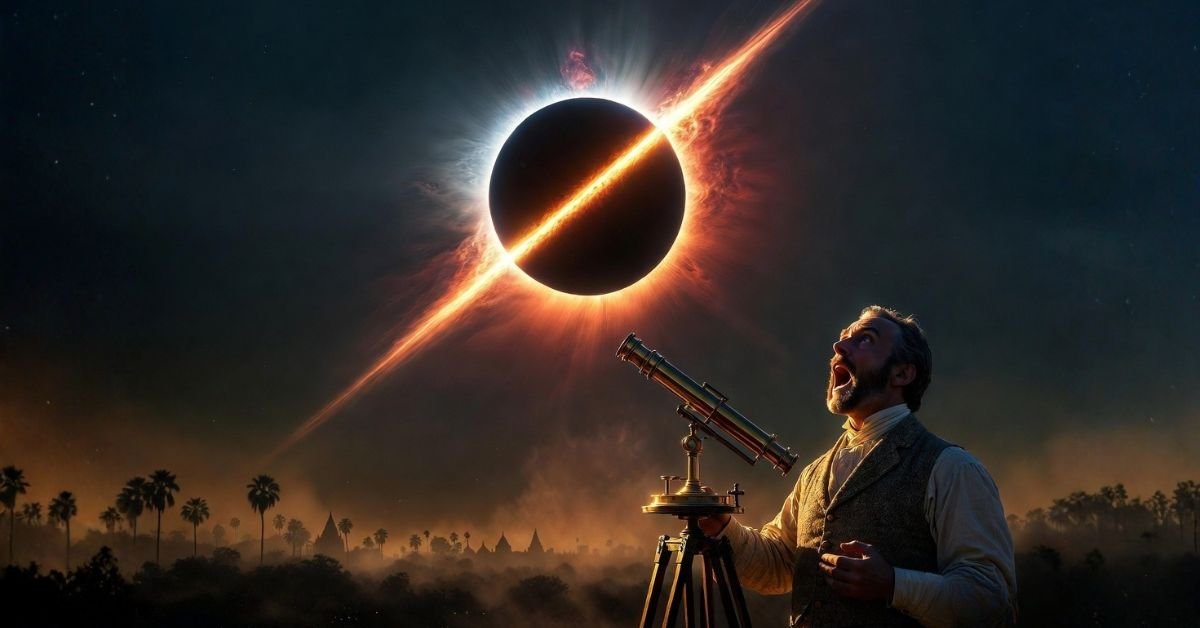
On 18 August 1868, the Moon’s shadow swept across southern India, and for a few minutes the town of Guntur stood in darkness.
In that brief window, a French astronomer pointed a spectroscope at the Sun’s flaming outer edge and recorded something in its light that would take science decades to explain.
Let us be precise about the claim, because it is often overstated: helium was not “discovered in India” in the way oxygen was discovered in a laboratory. What happened over Guntur was the first well-known observation of an unidentified yellow line in the Sun’s spectrum, a fingerprint with no known owner. The intellectual leap that this fingerprint belonged to a brand-new element came months later, in England. Moreover, proof that this element actually existed as a substance came 27 years later.
However, that is exactly what makes the story remarkable. Helium is the only element humanity detected in space before finding it on Earth, and the trail begins over Indian skies. Here is the full story, including the parts the tidy popular version usually leaves out.
The World Before Helium: Reading Light Like A Fingerprint
To understand why the 1868 eclipse mattered, you need to understand the scientific revolution that had just taken place: spectroscopy.
In the late 1850s, Gustav Kirchhoff and Robert Bunsen demonstrated that when any element is heated until it glows, it emits light at very specific wavelengths, a unique pattern of bright lines, like a fingerprint. Pass sunlight through a prism, and you can read those fingerprints in the Sun’s spectrum. Suddenly, chemists could identify what distant objects were made of without ever touching them. The composition of the stars, long assumed to be permanently unknowable, turned out to be written in their light.
By the 1860s, astronomers were racing to apply this new tool to the Sun. However, there was a problem. The Sun’s outer atmosphere, the chromosphere and the dramatic red prominences that leap from its surface, are normally invisible, drowned out by the blinding glare of the solar disc. In the 1860s, there was only one way to see it: wait for the Moon to block the Sun entirely during a total eclipse.
Total eclipses are rare, brief, and inconveniently located. Astronomers had to chase them across the globe. In August 1868, the path of totality crossed one of the most accessible regions available to European science: British India.
The Eclipse Of 18 August 1868
The eclipse of 1868 was exceptional even by eclipse standards. Totality lasted over six minutes along parts of its path, an unusually generous window. The shadow track ran across the Red Sea, through southern India, and onward to Southeast Asia.
Expeditions converged on India from across Europe, stationing themselves at multiple points along the path, among them Pierre Jules César Janssen, a French pioneer of solar spectroscopy, who observed from the Guntur region of present-day Andhra Pradesh, and British teams elsewhere on the track, including Lieutenant John Herschel (grandson of the discoverer of Uranus) and Norman Pogson of the Madras Observatory.
The shared goal was to point spectroscopes at the solar prominences during totality and read their chemical composition for the first time.
When totality came, the observers saw the expected bright lines of hydrogen in the prominences, and, in several accounts from that eclipse, a bright yellow line sitting very close to, but not quite matching, the famous double yellow line of sodium (the D1 and D2 lines). This new line, later designated D3, sat at a wavelength of about 587.5 nanometres.
Two honest caveats belong here. First, more than one observer along the path recorded the anomalous yellow line, so the neat single-hero version of the story simplifies a messier reality. Second, Janssen himself did not announce a new element, and historians have noted that his contemporary reports were focused elsewhere. What electrified him during those six minutes was something more practical: the prominence lines were so bright that he became convinced they could be observed without an eclipse at all.
The Morning After: A Method Born Under Indian Skies
The next day, Janssen tested his idea. Using his spectroscope in ordinary daylight, he successfully observed the solar prominences again, no eclipse required. It was a landmark moment in solar astronomy. For the first time, the Sun’s atmosphere could be studied on any clear day, from anywhere on Earth. This daylight method, arguably more than the yellow line itself, was the great scientific product of the Guntur observations.
Then comes one of the celebrated coincidences of nineteenth-century science. In England, the astronomer Joseph Norman Lockyer had been independently developing the same technique, and in October 1868, he too observed the prominences in daylight, recording the same unexplained yellow line. As the famous story goes, Janssen’s report from India and Lockyer’s from England reached the French Academy of Sciences almost simultaneously and were read at the same session. The anecdote is widely repeated and possibly polished over time. However, the Academy’s response is a matter of record: rather than adjudicate priority, France later struck a commemorative medal bearing both men’s portraits, a rare moment of scientific grace.
Naming An Element No One Could Touch
Lockyer went further than observation. After careful comparison, he and the chemist Edward Frankland concluded that the D3 line matched no element known on Earth. Lockyer made a bold proposal: the line belonged to a new element that existed in the Sun. He named it helium, from helios (ἥλιος), the Greek word for the Sun.
It is worth pausing on how audacious this was. Every other element had been discovered as a substance, something you could weigh, bottle, or burn. Helium existed only as a yellow line in a spectrum. There was no sample, no gas, no mineral, just a wavelength.
Many chemists were openly sceptical. Some suggested the line might come from a known element behaving strangely under the Sun’s extreme conditions. Others dismissed “helium” as astronomical speculation dressed up as chemistry. For 27 years, helium remained an element on probation, named, catalogued, and unproven. This is why credit for helium is properly shared across a chain of people: the eclipse observers of 1868 who recorded the line, Lockyer and Frankland who declared it a new element, and the chemists who finally caught it in a flask.
1895: The Sun’s Element Is Found On Earth
Vindication came in 1895, in a London laboratory. The Scottish chemist William Ramsay, already famous as the co-discoverer of argon, was investigating a uranium-bearing mineral called cleveite. When he treated the mineral with acid, it released a gas. Ramsay examined the gas with a spectroscope, expecting perhaps argon or nitrogen.
Instead, there it was: the same brilliant yellow D3 line recorded over India nearly three decades earlier. The solar element existed on Earth after all. Lockyer, by then in his fifties, finally saw with his own eyes the terrestrial glow of the element he had named. The Swedish chemists Per Teodor Cleve and Nils Abraham Langlet independently isolated helium from cleveite at almost the same time, confirming the result.
The source of the gas made perfect sense in hindsight, though nobody could have known it in 1868: helium in minerals is produced by the radioactive decay of uranium and thorium, and alpha particles are, quite literally, helium nuclei. The element seen in the Sun had been quietly accumulating inside Earth’s rocks all along.
Why Helium Was Hiding In Plain Sight
How did the second most abundant element in the universe escape detection on Earth for so long? The answer lies in helium’s peculiar character.
It is chemically inert, a noble gas that forms essentially no compounds, so it never shows up in chemical reactions. It is extremely light, so any helium released into the atmosphere gradually escapes into space; Earth’s air holds only about 5 parts per million. Moreover, it is colourless, odourless, and tasteless, giving chemists nothing to notice.
Helium could only be found by its light, which is exactly how it was found.
The Legacy For India And For Science
The 1868 eclipse left a legacy well beyond a single element.
For solar physics: The daylight prominence method transformed the study of the Sun from an occasional eclipse-chasing exercise into a daily science, laying the groundwork for the modern field.
For India: The great eclipse expeditions of the nineteenth century deepened the astronomical infrastructure of the subcontinent. The solar observation tradition they fed flows into the heritage of the Kodaikanal Solar Observatory (established 1899) and, eventually, the Indian Institute of Astrophysics. Whatever the fine print of priority, the first trace of helium was recorded over Indian soil, a fact worth knowing precisely rather than mythologically.
For science itself: Helium’s story demonstrated that the universe could contain matter unknown on Earth, and that light alone could reveal it. It was one of the founding triumphs of astrophysics.
The Irony Of The Modern Helium Story
The element born in sunlight went on to become quietly indispensable, and quietly scarce.
Liquid helium, at about −269°C, is the only practical coolant for the superconducting magnets inside every MRI scanner in the world. Helium is essential to cryogenics, particle accelerators such as the Large Hadron Collider, semiconductor and fibre-optic manufacturing, rocket fuel tank pressurisation, deep-sea diving gas mixtures, and precision leak detection. The party balloon is, economically speaking, the least important thing helium is used for.
Moreover, here is the twist that makes helium a genuinely strategic resource: on Earth, it is effectively non-renewable. Once released into the air, helium rises to the top of the atmosphere and escapes into space forever. Commercial helium is extracted almost entirely from a handful of natural gas fields, dominated by the United States and Qatar, with Algeria and Russia among other suppliers, and the global market has lurched through repeated shortage cycles over the past two decades.
For India, the irony is sharp. The country over whose skies helium’s first fingerprint was recorded imports virtually all the helium it uses for its MRI machines, research laboratories, space programme, and electronics industry. Supply security for helium is a growing concern for Indian science and industry, and efforts to identify domestic sources and improve helium recycling in laboratories are ongoing. The element that entered human knowledge through an Indian eclipse remains, a century and a half later, something India must buy from abroad.
There is a certain poetry in that. Helium was fleeting from the start, glimpsed in six minutes of darkness, escaping every open container, drifting off the top of the atmosphere. Holding on to it has never been easy.
Key Timeline
| Year | Event |
|---|---|
| 18 August 1868 | Total solar eclipse observed from Guntur and other Indian sites. Anomalous yellow D3 line recorded in solar prominences by Janssen and others. |
| 19 August 1868 | Janssen demonstrates daylight observation of solar prominences using a spectroscope. |
| October 1868 | Norman Lockyer independently observed the same yellow line in daylight from England. |
| 1868 | Lockyer and Edward Frankland propose that the line belongs to a new element and name it helium. |
| 1895 | William Ramsay isolates helium gas from the mineral cleveite in London. Independently confirmed by Cleve and Langlet. |
Frequently Asked Questions
Was helium discovered in India?
Partly, and the distinction matters. The first observations of helium’s spectral signature were made during the total solar eclipse of 18 August 1868, observed from India, with Pierre Janssen at Guntur the most celebrated of several observers who recorded the anomalous yellow line. The identification of that line as a new element was made later in 1868 by Norman Lockyer and Edward Frankland in England, and helium was first isolated as a physical substance by William Ramsay in 1895. India is where the trail begins.
Who gets credit for discovering helium?
Credit is shared across a chain: the 1868 eclipse observers (Janssen foremost among them) for the spectral observation, Lockyer and Frankland for identifying and naming a new element, and Ramsay, with Cleve and Langlet working independently, for isolating it on Earth in 1895.
Why is it called helium?
From helios, the Greek word for the Sun, because for its first 27 years, the Sun was the only place it was known to exist.
What is the D3 line?
The bright yellow emission line of helium at approximately 587.5 nanometres is named for its position near the sodium D1 and D2 lines. It was the fingerprint that gave helium away.
Is helium still being made in the Sun?
Constantly. The Sun fuses roughly 600 million tonnes of hydrogen into helium every second. Helium is not just found in the Sun; it is what the Sun spends its life making.
Why is there a helium shortage if it is so abundant in the universe?
Because Earth cannot hold on to it. Helium escapes the atmosphere permanently, forms no compounds, and can only be harvested economically from certain natural gas fields. Global supply depends on a small number of producing countries, which makes the market volatile.
The 1868 eclipse lasted barely six minutes over Guntur. In that window, observers recorded a line of yellow light that no element on Earth could explain, and humanity learned that a beam of light, read carefully enough, can carry the signature of undiscovered matter across 150 million kilometres of space.
About Author