
Table Of Contents
Pahalgam Massacre
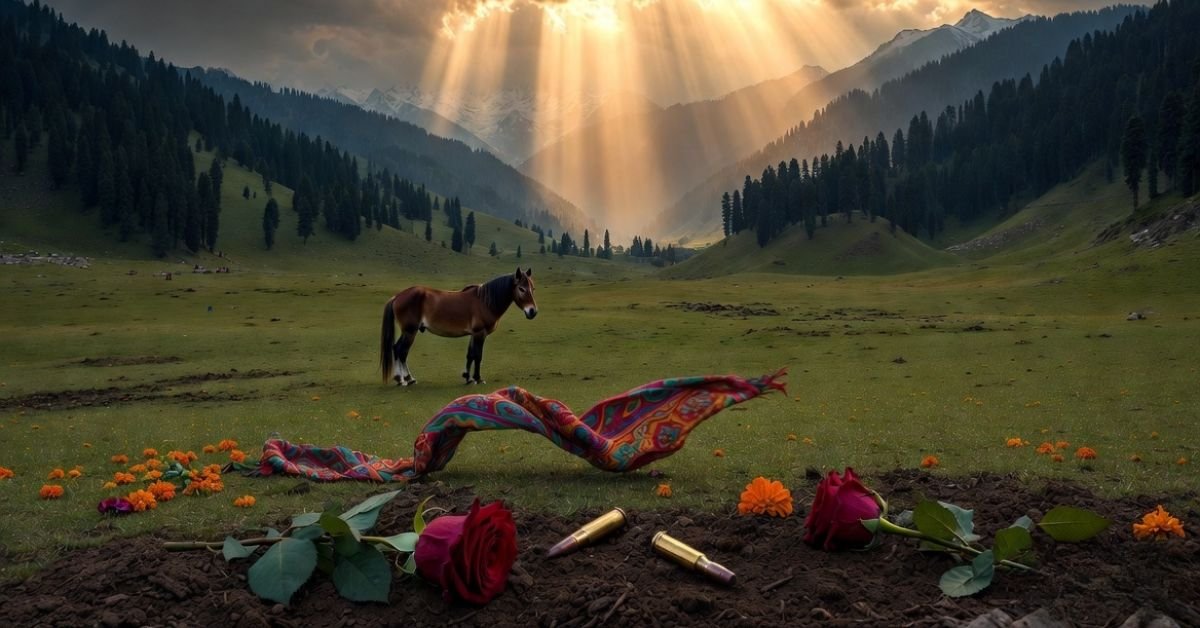
One year ago today, on April 22, 2025, the serene and picturesque Baisaran Valley meadow, widely celebrated as the “Mini Switzerland of Kashmir”, located approximately seven kilometers from Pahalgam town in the Anantnag district of Jammu and Kashmir, was transformed into a scene of unimaginable horror.
Three armed militants affiliated with The Resistance Front (TRF), a proxy outfit of the Pakistan-based Lashkar-e-Taiba (LeT), executed a meticulously planned and coordinated mass shooting that resulted in the deaths of 26 innocent men and left 20 others injured.
The victims included 24 Indian tourists drawn from multiple states across the country, one Nepali national, and a local Muslim pony handler who displayed extraordinary courage by attempting to intervene.
The assault stood out for its deliberate religious profiling, cold-blooded executions, and strategic choice of a soft civilian target, exposing critical gaps in tourist-area security even after the full integration of Jammu and Kashmir following the 2019 revocation of Article 370.
As the region observes the first anniversary under stringent security measures, with enhanced protocols at all major tourist destinations, sealed access to Baisaran Valley itself, and nationwide tributes to the fallen, this detailed retrospective offers a professional, fact-based analysis.
Drawing together every verified aspect of the incident, from its historical roots and minute-by-minute unfolding to the subsequent investigation, operational responses, geopolitical ramifications, and long-term consequences, the account underscores the attack’s profound human cost and its lasting imprint on India’s counter-terrorism posture, regional stability, and the socio-economic landscape of Kashmir.
Historical And Strategic Context: Post-2019 Kashmir And The Evolution Of Targeted Civilian Violence
The Pahalgam attack did not occur in isolation but emerged from a complex interplay of longstanding insurgency dynamics and newer post-2019 realities.
The abrogation of Article 370 in August 2019 ended Jammu and Kashmir’s special autonomous status, fully integrating the Union Territory into the Indian constitutional framework.
This landmark step enabled non-local Indians to purchase property, access government jobs, and participate more freely in economic development, measures that the central government described as essential for equitable growth, normalcy, and the erosion of separatist narratives.
For militant groups operating from across the border, however, these changes were portrayed as a form of demographic engineering that threatened the region’s distinct identity.
The Resistance Front, which first gained prominence around 2019 as a rebranded operational front for Lashkar-e-Taiba – a United Nations-designated terrorist organization with a history of high-profile attacks, including the 2008 Mumbai strikes – explicitly positioned itself in opposition to “non-local settlement.”
In the years leading up to 2025, TRF had demonstrated a tactical shift toward softer, high-visibility civilian targets such as tourists, pilgrims, and migrant workers, aiming to maximize psychological impact, disrupt economic recovery, and draw international attention.
Baisaran Valley, a high-altitude meadow measuring roughly 200 meters by 800 meters and surrounded by dense pine forests, was particularly vulnerable.
Accessible only by foot or horseback, enclosed by a simple seven-foot chain-link fence with just two entry gates, and reopened to visitors only two months earlier without permanent armed security deployment, the location represented an ideal symbolic soft target.
Intelligence assessments later confirmed that the perpetrators had conducted thorough reconnaissance, exploiting the meadow’s isolation and its popularity among families, honeymooners, and leisure travelers seeking its pristine natural beauty.
The Attack: A Chilling 25-To-30-Minute Ordeal Of Systematic Profiling And Execution
Between approximately 1:00 p.m. and 2:45 p.m.
On that fateful Tuesday, the three primary assailants emerged from the surrounding forests.
Dressed in a mix of military-style camouflage uniforms and, in one case, a traditional Kashmiri pheran to blend with the local environment, they were heavily armed with AK-47 assault rifles, M4 carbines, UHF communication radios, satellite phones (including a traceable Huawei device), and body-mounted cameras.
Eyewitnesses later recalled the militants calmly taking selfies amid the unfolding chaos, underscoring the premeditated and brazen nature of the operation.
The attackers moved with clinical efficiency.
They herded groups of tourists toward choke points near the meadow’s gates, separating individuals by religion through a series of deliberate questions: demanding names, forcing recitation of the Islamic kalima (the declaration of faith), and, in multiple documented instances, compelling men to lower their trousers to check for circumcision.
Hindu men, who formed the overwhelming majority of victims, were isolated and executed at point-blank range.
One Christian tourist was similarly killed after failing the religious test.
Women and children were largely spared, with some survivors reporting that the militants instructed them to “tell the story” directly to Prime Minister Narendra Modi.
The sustained firing lasted between 25 and 30 minutes, punctuated by celebratory bursts of gunfire.
Panic engulfed the meadow.
Tourists scrambled through gaps in the fence, sought cover behind mobile toilets, or climbed nearby trees in desperate attempts to escape.
An off-duty Indian Army officer vacationing with his family played a decisive role, organizing the evacuation of dozens of civilians and relaying urgent alerts to security forces.
Graphic videos recorded on smartphones, including one captured from a zipline, later surfaced, capturing the screams, the chaos, and the sight of bodies lying on the grass.
In a moment of profound bravery amid the horror, local Muslim pony operator Syed Adil Hussain Shah attempted to wrestle a weapon away from one of the attackers and was fatally shot while shielding tourists.
The first victim identified was newlywed Shubham Dwivedi from Kanpur, Uttar Pradesh, who was shot immediately after he identified himself as Hindu.
Indian Navy Lieutenant Vinay Narwal from Haryana, who had been honeymooning for just six days, was gunned down alongside his wife.
A father from Pune was shot three times, in the head, ear, and back, after failing to recite the required verses.
A Bengali Hindu professor survived by successfully reciting the kalima, while a Christian man from Madhya Pradesh was executed as the attackers posed with his body for photographs.
Wives pleaded for their husbands’ lives; children watched in terror as family members were singled out.
These firsthand accounts painted a picture of calculated communal targeting rather than random violence.
The Victims: A National Mosaic Of Lives Abruptly Cut Short
All 26 deceased were men, reflecting the attackers’ explicit selection criteria.
The toll comprised 24 Indian tourists representing 13 different states and union territories, one Nepali national, and Syed Adil Hussain Shah.
Maharashtra suffered the heaviest losses, with six killed and five injured.
Gujarat and Karnataka each reported three deaths and two injuries.
Other states that lost citizens included West Bengal, Madhya Pradesh, Arunachal Pradesh, Haryana, Uttar Pradesh, Bihar, Odisha, Kerala, Andhra Pradesh, and more.
Among the notable victims were:
- Shubham Dwivedi of Kanpur, a newly married young man whose wife Aishanya later recounted pleading with the militants.
- Lieutenant Vinay Narwal of the Indian Navy, whose honeymoon photograph beside his body became an enduring symbol of national grief.
- Bitan Adhikari is a US-based TCS technology professional from West Bengal.
- Tage Hailyang, an Indian Air Force official from Arunachal Pradesh.
- Syed Adil Hussain Shah, the local pony handler, earned recognition as a hero across communities for his selfless act.
The group also included an Intelligence Bureau personnel, a 17-year-old boy, an excise inspector from Bihar, realtors, accountants, and ordinary families on vacation.
Twenty others sustained injuries, many requiring prolonged medical care.
Across India, families received the bodies of their loved ones in coffins rather than souvenirs from a dream holiday.
One year later, survivors and relatives continue to navigate profound loss, preserving untouched bedrooms, struggling with names in conversation, and channeling grief into public testimony and calls for justice.
Perpetrators, Claims, And The National Investigation Agency Probe
The Resistance Front initially claimed responsibility through a Telegram channel on April 22 and 23, 2025, framing the assault as resistance to post-2019 “non-local settlement” and even releasing a photograph of the meadow.
The group retracted the claim on April 26, alleging a breach of communications and accusing Indian agencies of fabricating it.
A subsequent United Nations Security Council monitoring report independently confirmed the initial admissions.
The National Investigation Agency took over the case on April 27 and conducted one of the most exhaustive probes in recent memory.
In December 2025, the NIA filed a comprehensive 1,597-page chargesheet indicting both LeT and TRF as organizations, along with multiple individuals, including Pakistani handlers and local facilitators.
The three primary perpetrators were identified as Suleiman Shah (also known by aliases Bilal Afzal, Abu Hudun, and Faizal Jatt, a former Pakistan Special Service Group para-commando), Abu Hamza (Hamza Tahir Khan or Hamza Afghani), and Yasir (Hanan Zafar or Jibran).
All three were neutralized on July 28, 2025, during Operation Mahadev.
Forensic evidence included eyewitness identifications, satellite-phone tracking data, recovered weapons (including AK-103 variants and an M4 carbine), DNA matches, Pakistani identification documents, and financial trails routed through Malaysia and Gulf intermediaries.
Several local accomplices were arrested for providing logistical support, shelter, and reconnaissance.
Masterminds linked to LeT’s senior leadership network remain under active scrutiny, with India continuing to press Pakistan for full accountability and extradition.
India’s Multi-Pronged Response: Diplomacy, Precision Strikes, And Ground Operations
Prime Minister Narendra Modi immediately cut short an international engagement to chair an emergency meeting of the Cabinet Committee on Security.
India’s response was firm, calibrated, and multi-layered.
Diplomatic measures included suspending the 1960 Indus Waters Treaty, closing the Attari-Wagah border crossing, expelling Pakistani military advisers and diplomats, downgrading diplomatic ties, and imposing comprehensive visa restrictions.
On the operational front, two landmark actions defined the counter-offensive.
Operation Sindoor, executed on May 7, 2025, involved Indian Air Force precision missile strikes targeting nine Lashkar-e-Taiba and Jaish-e-Mohammed terror camps located in Pakistan and Pakistan-occupied Kashmir.
The strikes focused exclusively on terrorist infrastructure and training facilities, avoiding civilian and military installations.
Pakistan responded with counter-shelling along the Line of Control, resulting in some civilian casualties before a ceasefire was brokered on May 10.
Simultaneously, Operation Mahadev, launched within hours of the Pahalgam attack, represented a sustained 93-day intelligence-driven search.
Through coordinated efforts of the Indian Army, Central Reserve Police Force, and Jammu and Kashmir Police, supported by drone surveillance and satellite intelligence, the three perpetrators were tracked to the dense Harwan jungles near the Dachigam area.
On July 28, 2025, the terrorists were neutralized in a joint operation that showcased exceptional inter-agency synergy and technological edge.
Geopolitical Fallout And International Reactions
The incident briefly escalated tensions between India and Pakistan, with cross-border exchanges, airspace restrictions, and civil-defense drills on both sides.
Pakistan denied any state involvement and offered an inquiry, a position India firmly rejected, citing the clear Lashkar-e-Taiba and TRF linkages.
The United States responded by designating TRF a Foreign Terrorist Organization on July 17, 2025. Global condemnation was swift and unanimous.
The United Nations, European Union, G7, and QUAD nations expressed solidarity with India and reiterated the need for zero tolerance toward cross-border terrorism.
While some international observers raised concerns over the scale of subsequent counter-terror operations and detentions, the overwhelming consensus affirmed India’s right to defend its citizens.
One Year Later: Remembrance, Resilience, And Renewed Vigilance
On this first anniversary, Jammu and Kashmir remains on high alert.
Baisaran Valley is sealed and has been transformed into a site of solemn remembrance rather than recreation.
QR-code-based verification systems are now mandatory for visitors and service providers at all major tourist locations, including Betaab Valley and Aru Valley.
Pahalgam and the surrounding areas have seen a cautious recovery.
However, tourism, once a vital economic lifeline, generating 12 to 15 lakh visitors annually, experienced a sharp decline of over 50 percent in 2025, with nearly 50 sites temporarily closed before a phased reopening.
The Indian Army has publicly reiterated that “some lines should never be crossed,” signaling continued operational readiness.
Nationwide candle marches, memorial services, and anti-terrorism exhibitions honor the 26 victims.
Families of the deceased, while still grappling with irreparable loss, have found strength in collective remembrance and advocacy for stronger security frameworks.
Across Kashmir’s diverse communities, local voices have condemned the attack, emphasizing that terrorism finds no refuge in the Valley’s ethos.
Conclusion: Lessons In Unity, Security, And The Pursuit Of Lasting Peace
The 2025 Pahalgam massacre tested the resilience of the Indian state and the unity of its people.
It highlighted the persistent challenge of cross-border proxy terrorism while reaffirming the necessity of robust intelligence gathering, fortified tourist infrastructure, sustained diplomatic pressure on terror sponsors, and accelerated socio-economic integration in Jammu and Kashmir.
The sacrifice of Shubham Dwivedi, Vinay Narwal, Bitan Adhikari, Tage Hailyang, Syed Adil Hussain Shah, and the 21 other innocent lives demands more than remembrance; it calls for unyielding vigilance to ensure that the region’s valleys remain sanctuaries of peace, tourism, and shared prosperity for all.
India stands resolute: terrorism will not derail progress, communal harmony, or the democratic vision of a developed and inclusive Jammu and Kashmir.
The fight against terror continues through a combination of security measures, development initiatives, and the collective will of a nation united in grief and determination.
Jai Hind.
May the souls of the departed rest in eternal peace, and may their memory forever strengthen our resolve to safeguard every citizen and every corner of our motherland.
About Author