
Table Of Contents
On 10 May 2026, at a public rally in Secunderabad, Prime Minister Narendra Modi urged India’s citizens to defer gold purchases for one year.
He also called for restraint in foreign travel, destination weddings, fuel consumption through carpooling and work-from-home arrangements, cooking oil usage, and a preference for domestic (Swadeshi) products.
The immediate market and industry reaction was swift:
| Reaction Type | Immediate Impact |
|---|---|
| Stock Market | Titan and Kalyan Jewellers shares fell up to 11%; Senco Gold declined over 8% |
| Trade Bodies | 250 jewellers in Lucknow’s Aashiyana area observed a one-day shutdown |
| Political Response | Akhilesh Yadav and Rahul Gandhi described the appeal as “proof of failure” |
| Industry Warning | Jewellery associations highlighted risks to 35 million livelihoods |
This analysis examines the macroeconomic rationale behind the appeal, reviews the historical record of similar policy efforts, and assesses whether a public appeal represents an effective response.
It avoids the partisan framing common in much of the current commentary and focuses instead on evidence and outcomes.
The Macroeconomic Context
The government’s concern is grounded in tangible external-sector pressures.
As of early May 2026, India’s key vulnerability indicators are as follows:
| Indicator | Current Status (May 2026) | Change / Context |
|---|---|---|
| Forex Reserves | $690 billion (as of 1 May 2026) | Down from the $728 billion peak in February 2026 |
| USD/INR Exchange Rate | 95.33 (30 April low) | The Rupee has depreciated approximately 10% over the past 12 months |
| Gold Imports (FY26) | $71.98 billion | 24% increase from $58 billion in FY25 |
| Oil Import Dependence | 85–89% | Among the highest globally |
| Current Account Deficit | Projected 2.4–2.5% of GDP (Q3 FY26) | More than doubled from earlier estimates |
| Crude Oil Sensitivity | $13–14 billion impact per $10 rise | Exacerbated by the West Asia conflict |
These pressures stem from four interrelated factors: elevated oil prices linked to tensions in West Asia and risks to the Strait of Hormuz; outflows from foreign portfolio investors; the consequent rupee weakness, requiring RBI intervention; and surging gold imports that amplify foreign exchange outflows at a particularly inopportune moment.
“Prime Minister Modi’s recent appeal was largely aimed at conserving India’s foreign exchange reserves amid ongoing global economic uncertainty. India remains one of the largest importers of gold, and higher imports lead to significant dollar outflows.”
– Deveya Gaglani, Senior Research Analyst, Axis Direct.
The macroeconomic case is therefore legitimate.
The question is whether a moral appeal is the appropriate policy instrument.
The Unique Nature Of Indian Gold Demand
Gold consumption in India is fundamentally different from that in most other countries.
It serves simultaneously as savings, insurance, ritual requirement, and intergenerational wealth transfer, supported by a large informal financial ecosystem.
| Metric | Value | Context |
|---|---|---|
| Annual gold imports (FY26) | ~721 tonnes | Second-largest globally after China |
| Share of global demand | 26% | China accounts for 28% |
| Household gold holdings | 25,000–34,600 tonnes | WGC and Morgan Stanley estimates |
| Value of household gold | $2–3.78 trillion | Equivalent to approximately 88.8% of India’s GDP |
| Comparison to equity holdings | 3.1 times larger | Households hold three times more wealth in gold than in equities |
| Domestic production | 1.6 tonnes annually | Only 0.2% of the total demand; the remainder is imported |
This structure reveals three core realities: nearly all gold is imported, household gold holdings vastly exceed equity holdings, and cultural and financial roles are deeply intertwined.
Consequently, demand cannot be treated as discretionary spending that can be paused through public exhortation.
A Decade Of Policy Attempts: Lessons From The Record
The current appeal must be viewed against the backdrop of earlier initiatives under the Modi government.
| Scheme | Launched | Current Status | Outcome |
|---|---|---|---|
| Sovereign Gold Bonds (SGB) | November 2015 | Discontinued Feb 2025 | ₹72,274 crore mobilised; 146.96 tonnes |
| Gold Monetisation Scheme (GMS) | November 2015 | Discontinued Mar 2025 | Only ~31 tonnes mobilised over 10 years |
| Indian Gold Coin | 2015 | Largely dormant | Negligible traction |
| Gold Import Duty Adjustments | Multiple rounds | Active but reduced | Increased smuggling; demand largely unchanged |
Sovereign Gold Bonds proved effective in redirecting demand toward paper gold but were discontinued as rising gold prices made redemption costs exceed those of conventional borrowing.
The Gold Monetization Scheme failed primarily due to logistical constraints, unattractive returns relative to price appreciation, and households’ reluctance to part with family heirlooms.
“If we had spent the past decade building gold recycling infrastructure properly, we would not need to be making appeals today. The schemes existed. The will to make them work did not.”
The government’s decision to wind down these mechanisms just thirteen months before the appeal underscores why moral suasion has become a default tool.
Historical Precedent: The Gold Control Act Of 1968
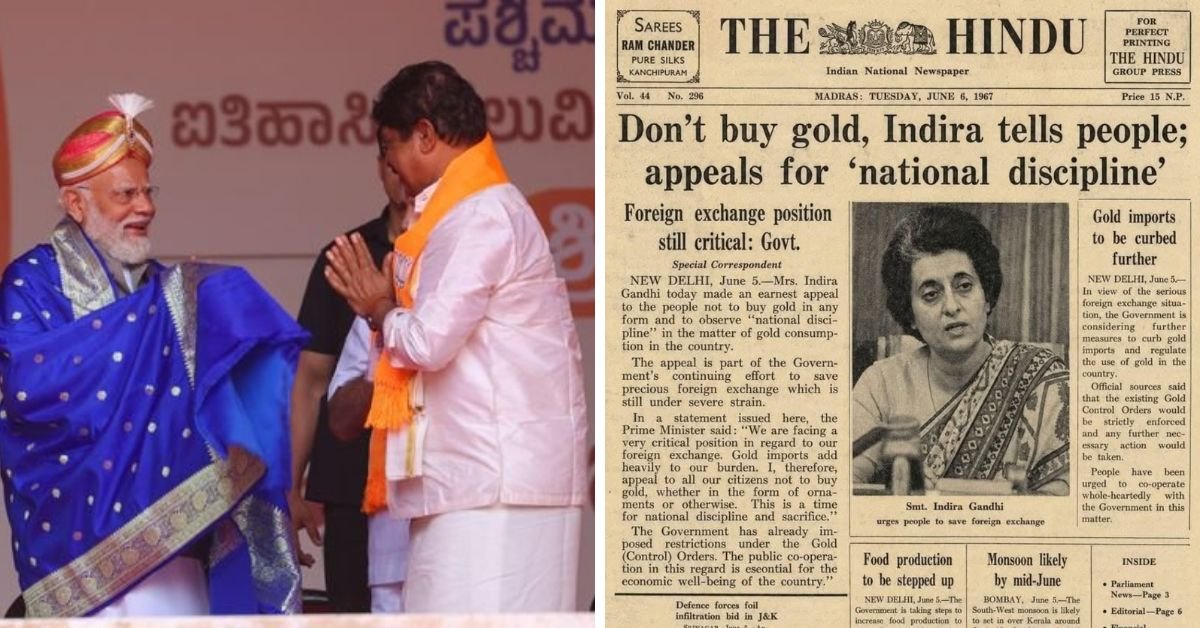
Claims comparing the current appeal to a 1967 Indira Gandhi appeal are unfounded; the widely circulated newspaper image has been confirmed as digitally altered by The Hindu, The Quint, NewsMeter, and Free Press Journal.
What actually occurred was legislative prohibition, not appeal.
The Gold Control Act of 1968 followed earlier restrictions and produced the following outcomes:
| Year | Action | Outcome |
|---|---|---|
| 1962 | Initial controls introduced | Forward trading banned; bank gold loans recalled |
| 1963 | Ban on jewellery above 14 carat purity | Limited compliance; significant artisan distress |
| 1965 | Gold bond scheme with tax immunity | Failed to mobilise meaningful holdings |
| 1968 | Gold Control Act enacted | Ban on private ownership of gold bars and coins |
| 1968–1990 | 22 years of restrictions | Widespread black market; severe impact on Sunar community |
| 1990 | Act repealed | Balance-of-payments crisis the following year |
| 1991 | India pledged 40 tonnes of gold | Avoided sovereign default |
Both the 1968 prohibition and the 2026 appeal rest on the assumption that state intervention can meaningfully alter demand for Indian gold.
Historical evidence suggests otherwise.
“What kind of ‘Amrit Kaal’ is this when the ‘Golden Bird’ lives in fear?”
– Akhilesh Yadav, Samajwadi Party Chief
Potential Outcomes And Distributional Impacts
A hypothetical full-year deferral of gold purchases could deliver first-order macroeconomic benefits of $50–70 billion in forex savings, modest rupee appreciation, and lower imported inflation. Global gold prices could decline sharply in the short term.
However, the second-order effects within India would be uneven:
- Karigars (Approximately 5 Million Directly Employed): Average monthly earnings of ₹15,000–16,000 at risk; 71% lack EPF coverage.
- Small Jewellery Businesses (Approximately 600,000 Shops): Predominantly family-run with limited diversification.
- Key Manufacturing Clusters: Thrissur, Coimbatore, Rajkot, Howrah, and Surat could face localized economic contraction.
- Gold Loan Sector: A ₹15 lakh crore market with implications for rural collateral and credit access.
- Women’s Financial Security: Disruption to stridhan traditions and intergenerational wealth transfer.
The macroeconomic gain, while real, appears modest relative to the concentrated impact on lower-income participants in the jewellery value chain.
Why The Appeal Is Likely To Have Limited Effect
Empirical evidence across multiple policy interventions demonstrates the inelasticity of Indian gold demand:
| Policy Measure | Period | Observed Result |
|---|---|---|
| Sovereign Gold Bonds | 2015–2023 | 146.96 tonnes mobilised (versus annual demand exceeding 700 tonnes) |
| Gold Monetisation Scheme | 2015–2025 | 31 tonnes over 10 years |
| Import duty hike (4% → 10%) | 2013 | Temporary slowdown; demand recovered within a year |
| Import duty hike (10% → 15%) | 2022 | Marginal effect; sharp rise in smuggling |
| Import duty reduction (15% → 6%) | 2024 | Official recognition that high duties had failed |
| Gold Control Act | 1968–1990 | Extensive black market and smuggling |
Demand is driven by non-deferrable factors: wedding and festival calendars, ritual obligations, investment habits among households with limited equity exposure, and generational transfers.
“Modi’s statement was an economic appeal, not a legal order. India remains one of the largest gold importers. However, India is a price taker rather than a price maker in international markets.”
– Sandip Raichura, CEO of Retail Broking and Distribution, PL Capital.
The probable outcome is modest short-term deferral among upper-decile urban consumers, near-normal festival and wedding demand, limited net forex relief, and unnecessary disruption to the jewelry ecosystem.
A Balanced Defense Of The Appeal
A measured case in support of the appeal includes the following points:
- Acute external shocks, such as the West Asia crisis, justify temporary collective restraint.
- Public appeals have succeeded in comparable crises elsewhere (South Korea 1997, Japan post-Fukushima).
- Signaling resolve can help stabilize currency markets even with partial domestic compliance.
- The measure avoids the larger distortions associated with higher duties or outright bans.
Even this defense acknowledges that the appeal functions primarily as a short-term holding measure rather than a structural solution.
The Required Long Term Reform Agenda
Sustainable reduction in gold import dependence requires structural changes rather than episodic appeals:
- Financialise Household Savings: Expand mutual fund access in Tier-3 and Tier-4 cities, introduce school-level financial literacy programs, and align tax incentives with gold’s perceived advantages (5–10 years).
- Revitalize Gold Monetization: Develop nationwide collection and assaying infrastructure, competitive returns, and seamless physical-to-digital conversion (2–5 years).
- Reduce Energy Import Dependence: Scale solar capacity to 500 GW, expand nuclear power, and accelerate green hydrogen (10–20 years).
- Develop Alternative Rural Credit Systems: Create formal collateral mechanisms that reduce reliance on gold (5–10 years).
- Strengthen Domestic Gold Markets: Fully operationalize the India International Bullion Exchange (IIBX) in GIFT City for transparent price discovery (2–3 years).
“Gold ETFs and Electronic Gold Receipts continue to remain policy-friendly because they help recycle domestic gold instead of driving fresh imports.”
– Sandip Raichura, PL Capital.
These reforms demand sustained political commitment and cannot be delivered within a single news cycle.
Practical Implications
- For Investors: Gold remains a relevant asset class in India. Secondary-market Sovereign Gold Bonds and gold ETFs offer efficient exposure. Jewelry stocks appear oversold in the short term but face structural headwinds over the medium term.
- For Households: Cultural and ritual purchases remain valid. For investment purposes, bonds and ETFs are preferable to physical gold. Diversification toward equities is advisable for long-term portfolios.
- For The Wider Economy: The appeal highlights genuine external pressures but fails to address underlying vulnerabilities. Import duty adjustments in the coming weeks will provide clearer insight into the government’s actual policy direction.
Conclusion
Prime Minister Modi’s appeal correctly identifies a genuine macroeconomic challenge but falls short as a durable solution.
It represents necessary short-term signaling during an external shock.
However, it treats a deeply structural issue as a matter of temporary restraint, shifts adjustment costs disproportionately onto vulnerable segments of the jewelry sector, and substitutes moral suasion for the policy reforms that were previously de-emphasized.
The jewelry industry protests reflect legitimate concern rooted in repeated historical experience.
The real policy question for India is whether the coming decade will finally deliver the structural changes needed to reduce its dependence on gold, or whether the country will continue to cycle through similar crises and responses.
That is the discussion policymakers and citizens should prioritize.
About Author